
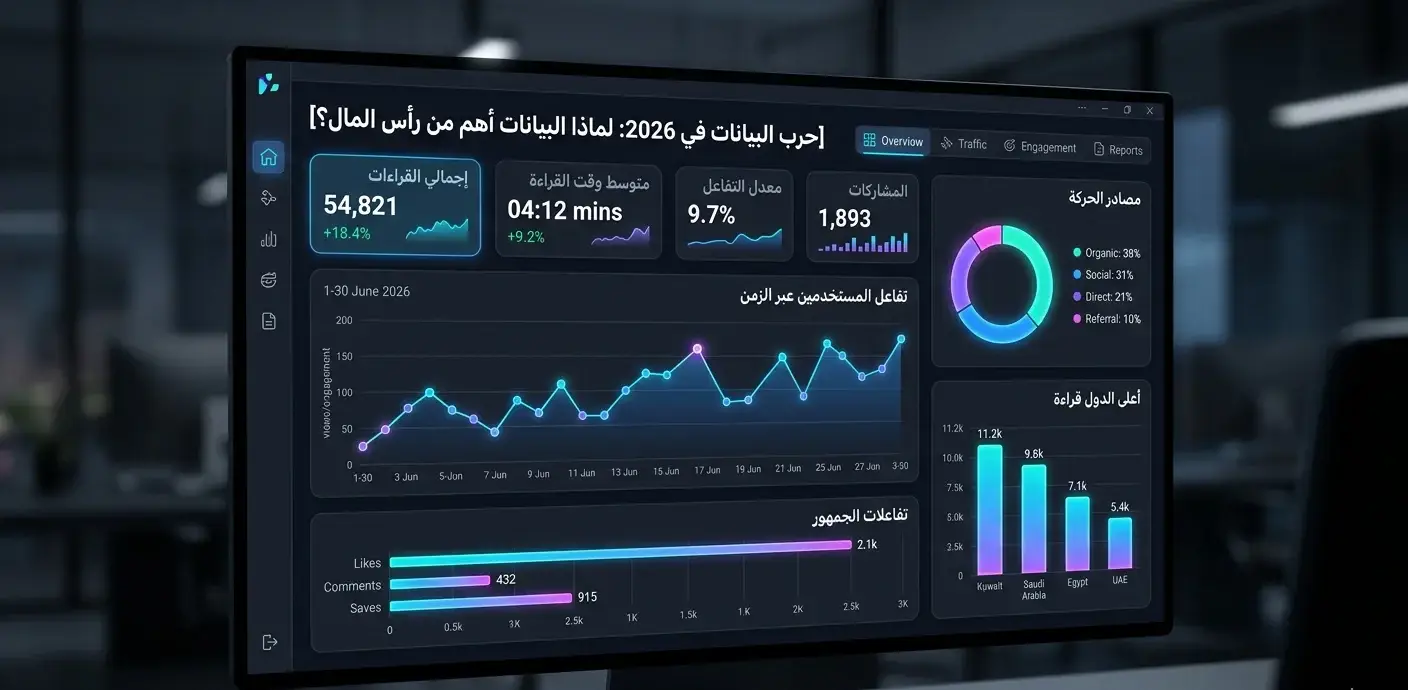
The Data War in 2026: Why Data Has Become More Valuable Than Capital
In 2026, the global economy is undergoing a fundamental transformation.
For decades, capital was considered the primary driver of economic growth. However, in the modern digital era, data has emerged as the most valuable strategic asset.
This shift raises a critical question:
Why has data become more important than capital in today’s economy?
: From Capital-Based to Data-Based Economies
Traditionally, economic power was determined by access to:
- Financial capital
- Physical infrastructure
- Industrial assets
In contrast, the modern digital economy is driven by:
- Data collection and processing
- User behavior analysis
- Predictive algorithms
- Real-time decision systems
Value creation has shifted from ownership of capital to control of data.
: Why Data Has Become the Most Valuable Asset
1. Data Powers Artificial Intelligence
Artificial intelligence systems depend entirely on large datasets to learn, improve, and function effectively.
Without data, AI systems cannot operate.
2. Data Enables Predictive Intelligence
Organizations use data to:
- Predict customer behavior
- Optimize operations
- Reduce risks
- Improve decision-making
This predictive capability creates a strong competitive advantage.
3. Data Creates Network Effects
The more data a system collects, the more intelligent it becomes.
This creates a self-reinforcing cycle where data accumulation increases dominance over time.
4. Data Is Difficult to Replicate
Unlike capital, data is continuously generated, context-specific, and extremely difficult to replicate, making it a unique strategic asset.
The Role of Capital in the Modern Economy
Although data has become dominant, capital remains essential for:
- Infrastructure development
- Technology investment
- Business scaling
- Market expansion
However, capital alone is no longer sufficient to ensure competitive advantage.
The New Relationship Between Data and Capital
In the modern economy:
- Capital funds innovation
- Data drives intelligence
- Intelligence determines success
This creates a system where data amplifies the value of capital, not replaces it.
: Who Owns the Data Owns the Market
In 2026, major platforms dominate the digital economy because they control:
- User behavior data
- Search and recommendation systems
- Digital interactions
- Algorithmic distribution channels
This control gives them significant influence over markets and consumer behavior.
The Role of Artificial Intelligence in the Data Economy
Artificial intelligence has accelerated the importance of data by:
- Increasing demand for large-scale datasets
- Enabling real-time analytics
- Automating decision-making processes
- Enhancing predictive accuracy
AI and data have become deeply interconnected systems.
The Future of Economic Power
The future economy is expected to be shaped by:
- Data ownership
- Algorithmic control
- Platform dominance
- AI-driven decision systems
Organizations that fail to adapt to this shift risk losing long-term competitiveness.
Conclusion
In 2026, data has surpassed capital as the most critical resource in the global economy.
While capital remains important, it is increasingly dependent on data to generate value and efficiency.
Ultimately, economic power is no longer defined by financial wealth alone, but by the ability to collect, analyze, and leverage data at scale.