
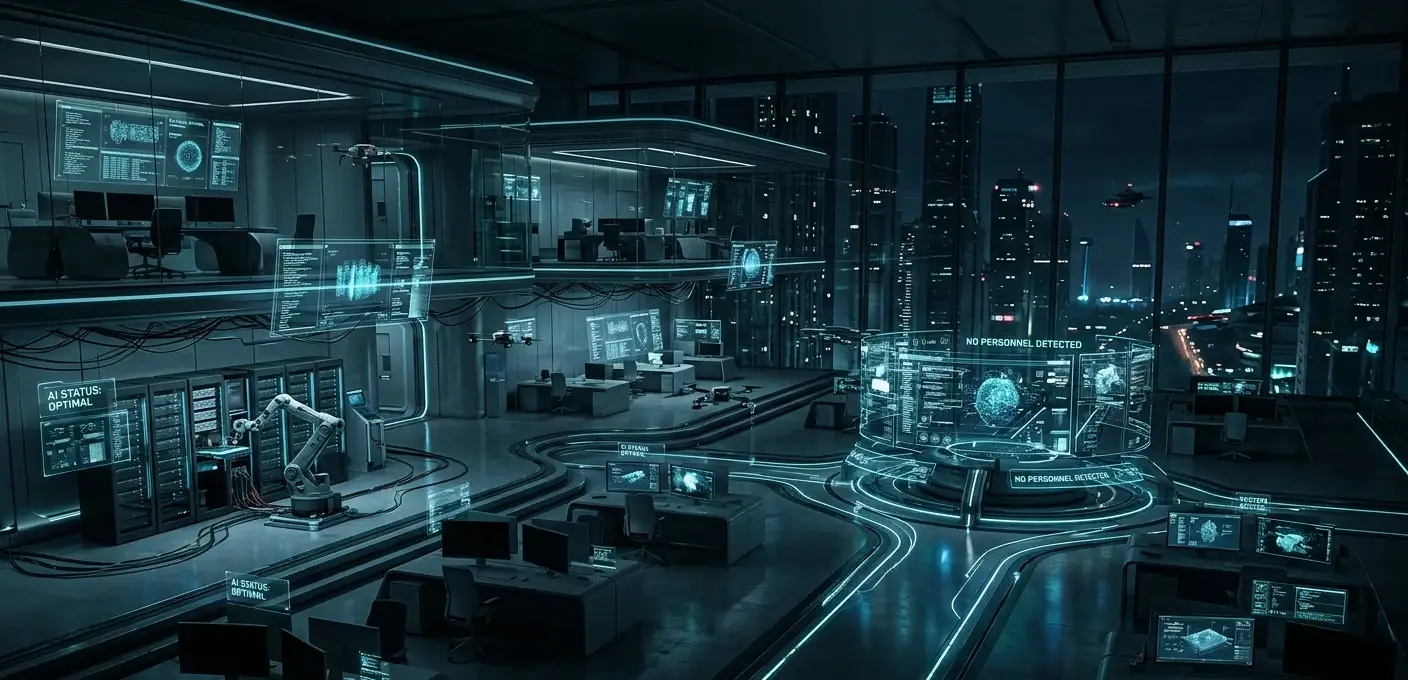
A Company Without Employees: How to Build a Fully Automated Business Using AI and Automation Meta Title
The concept of a “company without employees” is no longer theoretical in 2026.
With the rapid advancement of artificial intelligence and automation technologies, it has become possible to design and operate fully functional businesses with minimal or no human workforce.
This shift raises an important question:
Can businesses truly operate without employees in the modern digital economy?
The Rise of AI-Driven Businesses
Artificial intelligence has fundamentally changed how businesses operate.
Today, AI systems can handle tasks that previously required entire teams, including:
- Customer support
- Marketing and content creation
- Data analysis and reporting
- Workflow management
As a result, many companies are transitioning toward AI-first operational models.
What Does a “Company Without Employees” Mean?
A company without employees does not mean a company without humans.
Instead, it refers to a structure where:
- AI handles most operational tasks
- Automation replaces repetitive workflows
- Humans focus only on strategy and decision-making
In this model, traditional job roles are significantly reduced or eliminated.
Key Components of an AI-Automated Business
1. AI for Operations
AI systems manage daily operations such as scheduling, reporting, and process execution.
2. Automated Marketing Systems
Marketing can now be fully automated through:
- AI-generated content
- Automated ad campaigns
- Predictive customer targeting
3. AI Customer Support
Chatbots and AI assistants handle:
- Customer inquiries
- Ticket resolution
- 24/7 support systems
4. Data-Driven Decision Making
AI analyzes large datasets to provide insights and recommendations without human intervention.
Why Businesses Are Moving Toward Automation
Several factors are driving this transformation:
- Reduction of operational costs
- Increased efficiency and speed
- Scalability without hiring limitations
- Continuous 24/7 operations
Automation allows companies to grow without traditional workforce constraints.
The Role of Humans in AI-Driven Companies
Even in highly automated businesses, humans still play a critical role in:
- Strategic planning
- System design
- Ethical decision-making
- AI supervision and optimization
The role of humans is shifting from execution to oversight.
Advantages of a Company Without Employees
- Lower operational costs
- Faster execution cycles
- Higher scalability
- Reduced human error
- Continuous system availability
Limitations and Risks
Despite its advantages, this model has challenges:
- Dependence on technology infrastructure
- AI errors or system failures
- Lack of human creativity in certain areas
- Ethical and regulatory concerns
Conclusion
The idea of a company without employees is becoming increasingly realistic in 2026.
While humans are not fully removed from the equation, their role is shifting dramatically toward supervision and strategic control.
The future of business is not purely human or purely automated—it is a hybrid system where AI handles execution and humans guide direction.