
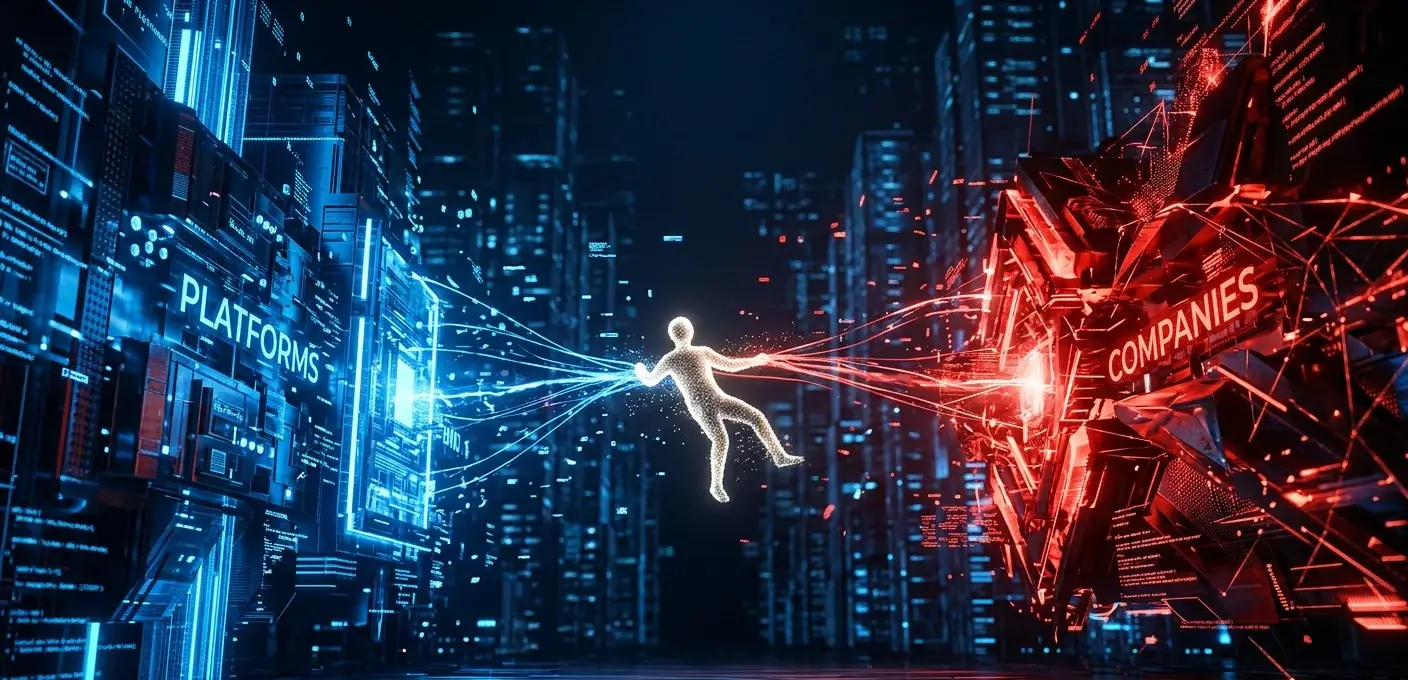
Who Owns the Customer in 2026? Platforms vs Companies – The Battle for Digital Control
The digital economy in 2026 is defined by a fundamental question: who owns the customer?
Is it the companies that create products and services, or the digital platforms that control access, data, and user interaction?
This question has become increasingly important as artificial intelligence, mobile ecosystems, and platform-driven technologies reshape how users engage with digital services.
The Evolution of Customer Ownership
In the traditional digital model, companies maintained direct relationships with their customers through websites, physical stores, and direct communication channels.
However, this model has significantly changed.
Today, users primarily interact through intermediaries such as:
- Social media platforms
- Mobile application ecosystems
- Search engines
- AI-powered assistants
As a result, platforms have become the primary gatekeepers between companies and customers.
Why Platforms Dominate Customer Access
1. Control of User Attention
Platforms determine what users see through algorithmic recommendation systems, effectively controlling visibility and engagement.
2. Ownership of Data
User behavior data is collected, processed, and monetized primarily by platforms, giving them a significant strategic advantage.
3. Distribution Power
Companies increasingly rely on platforms to reach customers, whether through app stores, search engines, or social media feeds.
The Role of Companies in the New Digital Ecosystem
Despite the dominance of platforms, companies remain essential actors in the digital economy.
Their core responsibilities include:
- Product and service innovation
- Brand development and positioning
- Customer experience design
- Operational execution
However, their direct control over customer relationships has weakened.
The Power Imbalance Between Platforms and Companies
In 2026, the relationship between platforms and companies is highly asymmetric.
- Platforms control visibility, access, and engagement
- Companies control products, services, and brand identity
This creates a dependency structure where companies rely heavily on platforms for market access.
The Impact of Artificial Intelligence
Artificial intelligence has further intensified this shift.
AI systems now:
- Filter and prioritize information before it reaches users
- Provide direct answers without requiring website visits
- Influence decision-making processes
As a result, AI has become an additional intermediary in the customer journey.
The Rise of Closed Digital Ecosystems
Modern digital environments such as:
- Mobile operating systems
- App marketplaces
- Social media platforms
operate as closed ecosystems (walled gardens), limiting direct access between companies and users.
Who Truly Owns the Customer in 2026?
The answer is complex and no longer absolute.
- Platforms control access and distribution
- Companies own products and brand identity
- AI systems increasingly mediate interactions
Therefore, customer ownership in 2026 is fragmented rather than centralized.
Conclusion
Customer ownership in 2026 is no longer held by a single entity.
Instead, it is distributed across platforms, companies, and AI systems.
While platforms have become the dominant gatekeepers of attention and data, companies still play a critical role in innovation and value creation.
In this new digital reality, success depends not on direct ownership of the customer, but on the ability to operate effectively within platform-controlled ecosystems.