
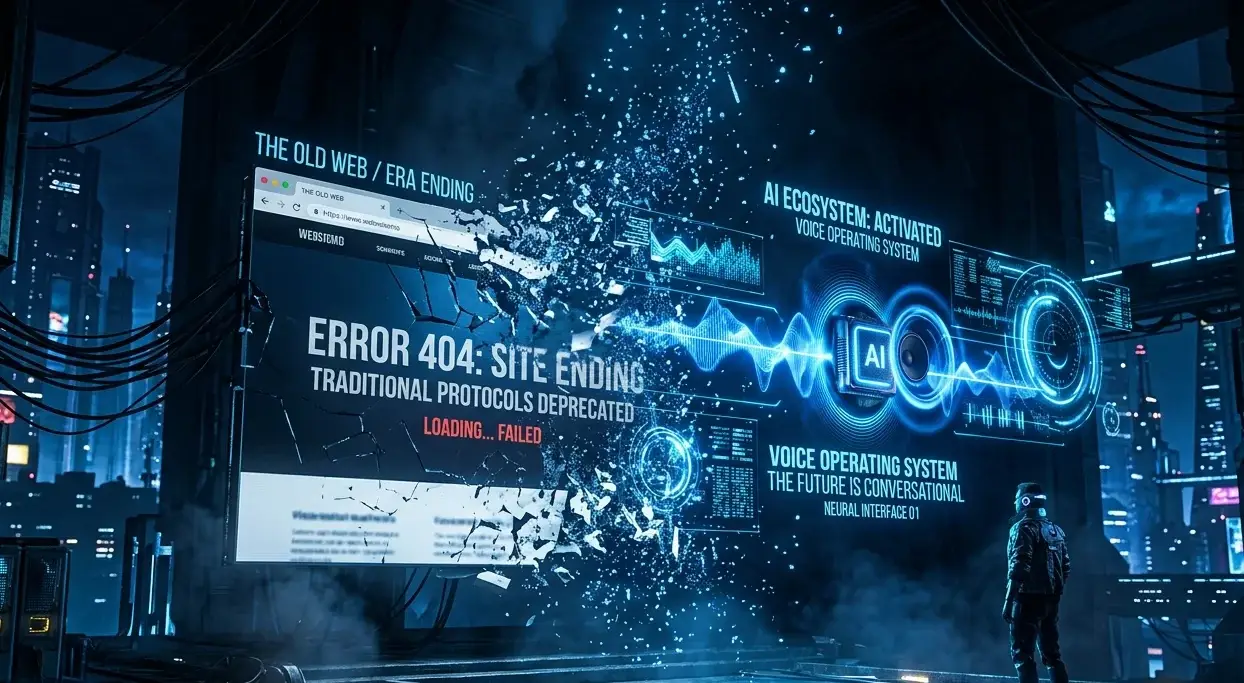
The Future of Websites in 2026: An Analytical Study of Digital Transformation and User Behavior
Over the past decade, the digital landscape has undergone significant transformation. By 2026, it has become evident that user behavior is no longer primarily centered around traditional websites. Instead, users increasingly rely on artificial intelligence systems, mobile applications, and short-form content platforms to access information.
This study aims to analyze this shift and examine the evolving role of websites within the modern digital ecosystem.
Changes in Digital User Behavior
Recent behavioral trends indicate a clear shift in how users interact with online content.
Key changes include:
- Reduced reliance on traditional website browsing
- Preference for instant and direct answers
- Increased use of mobile applications
- Shift toward short and concise content consumption
This reflects a broader transition from exploratory browsing to immediate information retrieval.
The Impact of Artificial Intelligence on Search Behavior
Artificial intelligence has significantly reshaped how users access information online.
Instead of visiting multiple websites, users now:
- Ask AI-powered systems directly
- Receive structured, instant responses
- Avoid traditional multi-page navigation
As a result, AI has become a primary interface for information retrieval, reducing the dependency on websites as the first point of access.
The Role of Mobile Applications
Mobile applications have become a dominant force in digital interaction due to their efficiency and user-friendly design.
They offer:
- Faster performance
- Seamless user experience
- Real-time notifications
- Personalized content delivery
This has positioned mobile apps as strong competitors to traditional websites in terms of user engagement.
Social Media as an Emerging Search Ecosystem
Platforms such as TikTok, Instagram, and YouTube Shorts have evolved beyond entertainment tools.
They now function as:
- Information discovery platforms
- Alternative search engines
- Product and service recommendation systems
This shift highlights a fundamental change in how users discover and consume information.
The Current Role of Websites
Despite reduced dominance as a primary entry point, websites remain essential in the digital ecosystem.
Their current roles include:
- Establishing official brand identity
- Supporting search engine optimization (SEO) strategies
- Providing in-depth and structured information
- Enhancing digital trust and credibility
Thus, websites have transitioned from primary access points to authoritative reference sources.
The Emerging Digital Ecosystem
The traditional role of websites has not been replaced by a single technology but by an integrated ecosystem consisting of:
- Artificial intelligence systems
- Mobile applications
- Short-form content platforms
- Closed digital ecosystems (walled gardens)
This ecosystem has fundamentally changed how information is distributed and consumed.
The Future of Websites
The future of websites depends on their ability to adapt to technological advancements.
Successful websites are expected to:
- Offer fast loading performance
- Integrate artificial intelligence features
- Provide enhanced user experience
- Be optimized for machine readability and search engines
In contrast, static and outdated websites are likely to decline in relevance.
Conclusion
This study concludes that websites have not disappeared in 2026; however, their central role in the digital ecosystem has significantly diminished.
The internet has evolved into a system driven by speed, intelligence, and instant information delivery, redefining the function of websites as reference points rather than primary entry gateways.